
Sunday, 6 April 2014


Monday, 3 March 2014

Saturday, 1 March 2014

Thursday, 27 February 2014
Affect Life- Mediated Life
Reference
Dixon, N. Affect Lab (2013) The Selfie: To Live is to be Photographed. Available from: http://affectlab.org/tag/mediated-life/ [Accessed 27 February 2014]
I have come across this website that looks at articles, media coverage and user-generated content from different authors and producers. I thought this particualr page is interesting as it has extracts from various books that link to what i am studying.
Van Dijck, J. (2007) Mediated Memories in the Digital Age. California: Stanford University Press.
Whereas their parents invested considerable time and effort in building up material collections of pictures for future reference, youngster appear to take less interest in sharing photographs as objects than as sharing them as experiences. [p.114]
Digital photography is part of this larger transformation in which the self becomes the centre of a virtual universe make up of informational and spatial flows, individuals articulate their identity as social being not only by taking and storing photographs to document their lives but also by participating in communal photographic exchanges that mark their identity and interactive producers and consumers of culture.
From the above observations it is tempting to draw the conclusion that digital cameras are moving away from their prime functions as memory tools, instead becoming tool for identity formation, communication, and experience. If photographs were always a medium for remember scenes and objects from the past, digital cameras particularly encourage users to imagine and invent the present. [p.116]
Dixon, N. Affect Lab (2013) The Selfie: To Live is to be Photographed. Available from: http://affectlab.org/tag/mediated-life/ [Accessed 27 February 2014]
I have come across this website that looks at articles, media coverage and user-generated content from different authors and producers. I thought this particualr page is interesting as it has extracts from various books that link to what i am studying.
José Van Dijck Mediated Memories in the Digital AgeReference
Van Dijck, J. (2007) Mediated Memories in the Digital Age. California: Stanford University Press.
Whereas their parents invested considerable time and effort in building up material collections of pictures for future reference, youngster appear to take less interest in sharing photographs as objects than as sharing them as experiences. [p.114]
Digital photography is part of this larger transformation in which the self becomes the centre of a virtual universe make up of informational and spatial flows, individuals articulate their identity as social being not only by taking and storing photographs to document their lives but also by participating in communal photographic exchanges that mark their identity and interactive producers and consumers of culture.
From the above observations it is tempting to draw the conclusion that digital cameras are moving away from their prime functions as memory tools, instead becoming tool for identity formation, communication, and experience. If photographs were always a medium for remember scenes and objects from the past, digital cameras particularly encourage users to imagine and invent the present. [p.116]
Group Crit Session
After today's group crit session, I have chosen to focus on a more specific subject from my original idea, to look at the mediated lives referring to a photo album photograph to a image posted online via Instagram, and how that has revolved over the years.
Using this idea I can look into how the physical photo album has died out and what was once an item cherished by only the family who posses it, has changed to today, the personal images we would use then are now instantaneously openly published online for anyone to view. I want to research journals and theorists who show why this may have happened and what may of let this happen, maybe how the idea of evolution and technology has advanced in knowledge leading us to cheaper cameras, cheaper smart phones, which makes it more cheaper and accessible for people to use.
Using this idea I can look into how the physical photo album has died out and what was once an item cherished by only the family who posses it, has changed to today, the personal images we would use then are now instantaneously openly published online for anyone to view. I want to research journals and theorists who show why this may have happened and what may of let this happen, maybe how the idea of evolution and technology has advanced in knowledge leading us to cheaper cameras, cheaper smart phones, which makes it more cheaper and accessible for people to use.
Wednesday, 12 February 2014

Monday, 10 February 2014
Critical Analysis Essay Research- Instagram
Instagram- A social networking site where you can publish images of anything you wish from where you visited today to your new hairstyle! Users can also comment on photographs and publically 'like' them with a press of a button.
I want to investigate the use of social networking sites such as Instagram and how people document their lives to a certain extent to where people can find out where you're location is to the meal you're about to eat.
I want to investigate the use of social networking sites such as Instagram and how people document their lives to a certain extent to where people can find out where you're location is to the meal you're about to eat.
BBC NEWSNIGHT Interview
The Tinder Phenomenon
Youtube video (no longer available on BBC iPlayer)
I also feel that this app is very intimidating and almost absurd as you can only judge what the persons personality may be like or the chemistry/attraction you may get between each other by the use of their profile picture.
It also may be slightly dangerous as they could put any photograph online and it may not even be them! As well as finding you matches based on your location, is it really worth broadcasting your every move?
Reference
BBC Newsnight (2013) NEWSNIGHT: The tinder phenomenon. Youtube [Video] 12 December. Available from: http://www.youtube.com/watch?v=mBOSJI3gIZA [Accessed 10 January 2014]
My Idea -Critical Perspectives
Notes
Social media- instagram
How people document their lives in images day to day- one click and its available to see all over the world. Things that may be considered to be private.
Wrong or right?
Social media- instagram
How people document their lives in images day to day- one click and its available to see all over the world. Things that may be considered to be private.
Wrong or right?
- Selfies
- Sharing locations
- Paper photo albums usage decreasing
- Used for fame- gain followers
- Celebrity influences
- Your children, places you go, your home, yourself (some more revealing than others)
- The act of survailance
- Beyoncé- self museum?
- News night interview Paxsman
- Terms and condtions -Facebook, Instagram
- Film- The lives of others
- Tinder
- Adam Curtis- Blog*
Tuesday, 26 November 2013
Conclusion Of The Project
Once finishing this project I realised that our group was lacking in communication which led us unable to visit the site as a team. We all kind of split and started to work individually but still around the same subject. I also realised that if we were to actually carry out the project it wouldn't be very reliable as there was no safe place to put the cameras or to guarantee we'd even retrieve any photographs from it. With this in mind it would jeopardise the whole idea.
If I were to do this again I would maybe work amongst a smaller group of up to 3 as it would be easier to communicate between each other, I would also use a different idea and arrange various pre-visits to the site to see if the idea was practical and would be successfully carried out.
Monday, 4 November 2013
WEEK 3
Finalising Plans
Our Idea;Our group came up with the idea to place a number of disposable cameras in two separate locations, and leave them there for a day/night, where members of the public will have the chance to use the cameras to take images of anything they want in that area. There will be signs next to the cameras to give the public an insight on the project and what has to be carried out, also there will have to be regular monitoring on the cameras from members of the group, incase they become damaged or unable to produce images. It will be very interesting to see the differences in the images taken, as we have chosen two very opposite locations. Clifton being a very middle to high class area in Bristol, with busy shops and cafe's, to businesses and a University. Whereas The Bear Pit, although still thought to be very well-known in the Bristol area, has a lot more middle to low class residents in and around it. With it being a large underpass from Stokes Croft to the Broadmead city centre, there is rarely a time where its not busy which can also become a place many people avoid during weekend nights as there are many intoxicated and homeless people passing through there and even sleeping in the small tunnels. I think this idea of the project will be very successful in showing the contrast within the areas and how much variety places in Bristol have.
We planned that once we have gone through with the project and seen the pictures we have got, we want to display some of them within the 2 locations for example in a shop window.
- Where we are going: Stokes Croft, The Bearpit, Bristol & Clifton, Bristol.
- Travel: Walking as the Bear Pit is walking distance from where I live, but also Bus travel may be needed to reach parts of Clifton.
- Identified risks in the risk assessment require a change in our initial plans? The risks identified in our risk assessment require no change to our initial plans as they have been carefully thought through.
- What we are going to look at while we're there: I will look at where we may want to place the disposable cameras, the average amount of people around the area at the times I visit them and the area in general to be able to have a bigger knowledge and understanding of our chosen areas.
- How we will record our findings: I will record my findings by taking photographs as I travel around the areas, so I am able to look back on what i have taken from the visits and also take notes.
Tuesday, 29 October 2013
WEEK 2
Seminar Preparation Task
Practitioners I admire:
- Barbara Kruger

- Nick Knight

- Alexey Titarenko

- Solve Sundsbo

As for the fashion photographers this may not always be the case as their work is promotional based and would get the best results by displaying there work around the most well known art galleries such as Tate Modern London, Victoria & Albert Museum and The Museum of Contemporary Art Los Angeles. Exhibiting your work in such high end popular places, would give you large publicity and acknowledgement from people interested in your work.
Research Task
Locations our group has chosen:
- The Bear Pit, Stokes Croft
- Clifton
Risk Assessments:
The Bear Pit- Stokes Croft- Bristol

Clifton- General area- Bristol

Wednesday, 16 October 2013


Nick Brandt

Nick Brandt was born in London, England, 1966. He is a photographer who bases his work in Africa. He does this to be able to photograph and record the wild animals and places before they become destroyed from the hands of man.
He uses a medium-format black and white film camera, without zoom lenses. Most of his work is of panoramas of animals in wonderful landscapes and graphic portraits. He likes to photograph the animals up close to be able to portray their personalities.
He quotes- "You wouldn't take a portrait of a human being from a hundred feet away and expect to capture their spirit; you'd move in close."
Some of his work:


Website http://www.nickbrandt.com/
James Nizam

I am particularly interested in his series of light installations called "Trace Heavens" as they are very beautiful images and they have a very unique style. To create them Nizam made incisions into a structure of a house to be able to experiment and manipulate sunlight into light sculptures.


Light Installations:


Other work:


Website http://www.jamesnizam.com/
Thursday, 10 October 2013
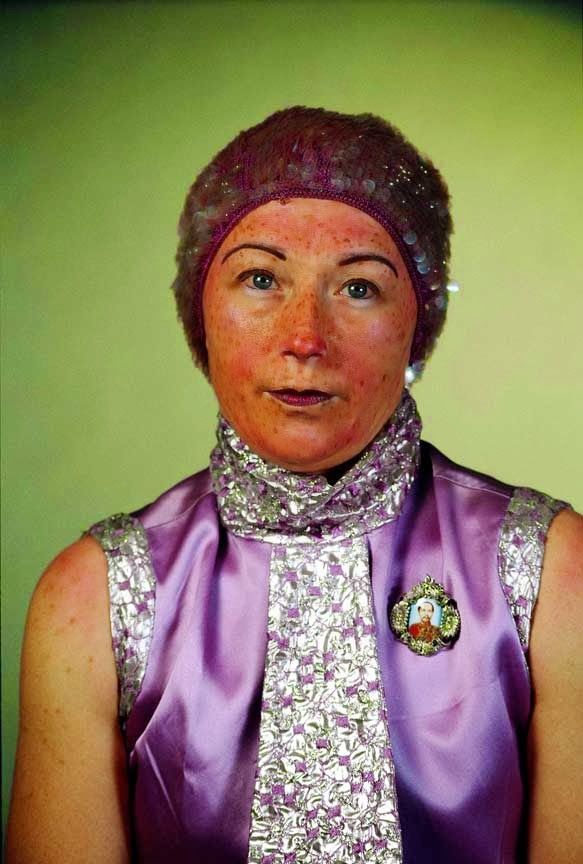
Cindy Sherman

Cindy Sherman is an American conceptual Photographer and also a film director. She was born in 1954, New Jersey, and is mostly known for her portraiture photography.
She creates and photographs sets in which she appears as various characters. She does this in order to borrow from certain particularities of stereotypical images of women in popular media, which makes audiences recognise the original stereotypical image. She also titles each image as 'Untitled' to depersonalise the images as she wants people to see the meaning and the character in the image rather than the photographer taking a self portrait. Sherman likes to use herself to comment on a variety of issues such as;
- The role of women
- The role of the artist
Extract from the book Her Bodies
Rossalind Krauss- '..the condition of being a copy without being an original.'.
Some of her work




Subscribe to:
Posts (Atom)